L. David Roper
http://www.roperld.com/personal/roperldavid.htm
4 April, 2016
The science is absolute that greenhouse gases trap solar energy near the Earth surface. The Earth would be a very cold planet, not fit for human habitation, if that were not true. Increasing trapped energy due to increasing greenhouse gases is not always expressed as increasing average temperature of the Earth.
Many climatologists have replaced the term "Global Warming" by the term "Climate Change" to indicate that trapping of solar energy near the Earth surface causes more than an average temperature increase of the atmosphere. In fact, it is possible that atmospheric average temperature decreases for some limited period of time even as the trapped energy increases.
A better term for the trapping of solar energy near the Earth surface might be "Global Heating." The effects of Global Heating are numerous, some of which are:
The term Climate Change does not include all the effects of Gobal Heating.
Although the effects mentioned above increase on the average across the Earth, specific regions may experience decreases in one or more of them. For example, decreasing atmospheric temperature may occur in some region while it is increasing in another region.
Weather is not climate, which is long-term average of weather. Do not confuse weather with climate.
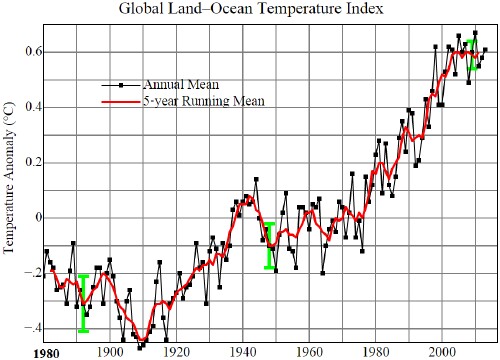
Global Heating due to greenhouse gases emitted into the atmosphere can be made more believable by looking at how heat energy is accumulating in the earth, oceans and atmosphere.
http://en.wikipedia.org/wiki/Global_warming#mediaviewer/File:Global_Temperature_Anomaly.svg:
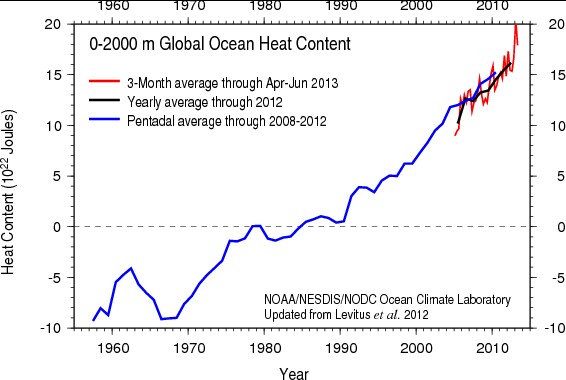
http://www.epa.gov/climatechange/pdfs/print_ocean-heat-2014.pdf:
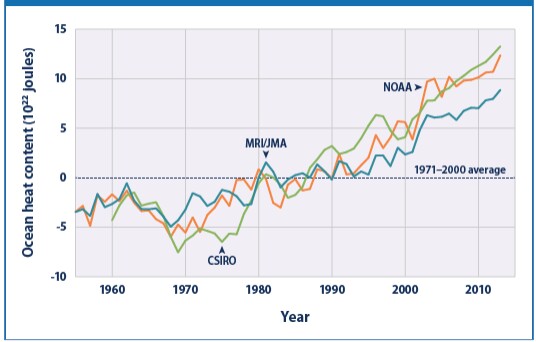
http://www.skepticalscience.com/graphics.php?g=65:
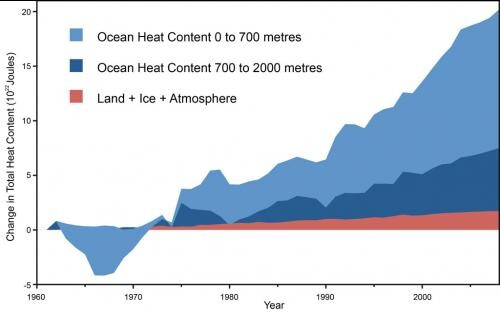
http://en.wikipedia.org/wiki/El_Ni%C3%B1o_Southern_Oscillation:
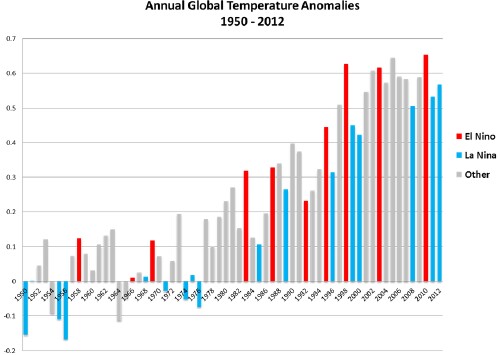
Global atmospheric warming fluctuates according to the existence of the Pacific-Ocean currents El Niño and La Niña. El Niño is predicted for 2014 and 2015, so global atmospheric tempertures will probably increase out of the recent leveling.
Roper Global-Heating Web Pages
L. David Roper interdisciplinary studies