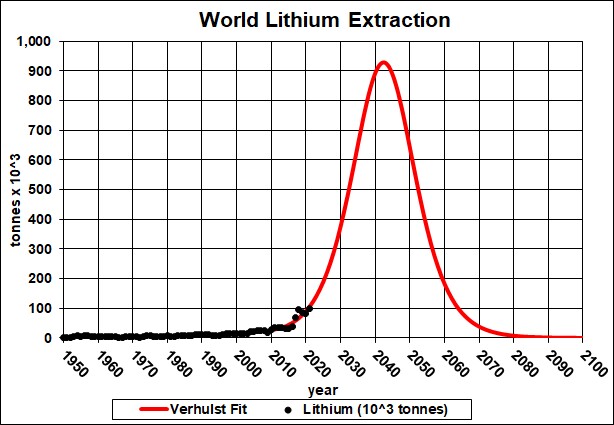
Lithium extraction rate for the world and a Verhulst function fit to the data.
L. David Roper
http://www.roperld.com/personal/RoperLDavid.htm
24 October, 2022
Lithium is used to make modern batteries: Lithium-Ion and Lithium-Ion-Iron-Phosphate. The graph below shows the lithium extraction data for the world and a Verhulst function fit to the data in order to extrapolate into the future.
Lithium extraction rate for the world and a Verhulst function fit to the data.
The red curve is a fit with total amount to be extracted of 20x106 tonnes, which is approximately equal to the amount already extracted plus the USGS estimate of world reserves (14x106 tonnes). An assumption was made that the depletion curve is symmetric.
For 2002-2005 the main U.S. import sources for lithium were: Chile: 74%; Argentina: 24%. Bolivia may be a major source in the future. See http://en.wikipedia.org/wiki/Salar_de_Uyuni.
It appears that world-lithium extraction will peak at ~2040.
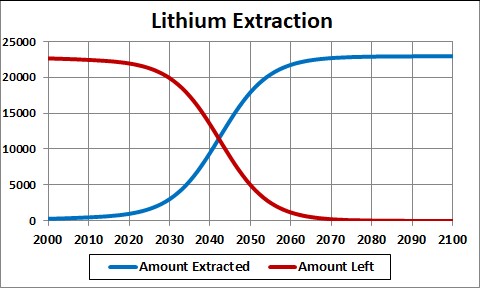
Taking an average extraction curve of the two fits, the crossover point at year ~2039 when the amount extracted is equal to the amount left to be extracted is shown here:
Assume that:
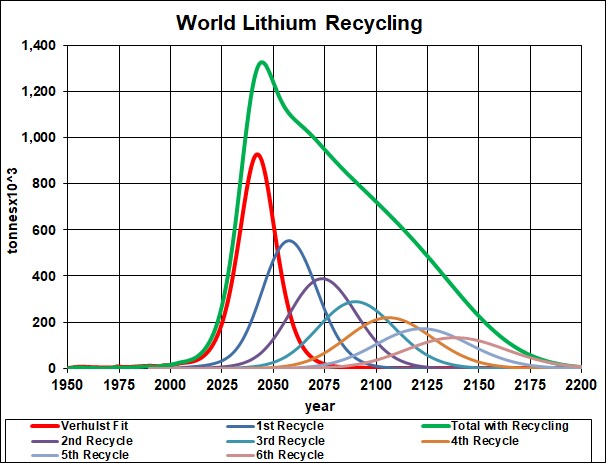
The effective lithium available for making items after the first ten recycling cycles is shown in the following graph, along with the effective lithium available for each cycle:
The equation for a recyling cycle is
 ,
,
where Ei is the amount available from the previous cycle. Here is an example of the Excel coding:
{=(($J$2+$I$2)/2+(($J$2-$I$2)/2)*TANH((A27-$K$2)/$L$2))*SUM($I$27:I27*(EXP(-1*((A27-$A$27:A27-$N$2)/$O$2)^2/2))/$O$2/SQRT(2*PI()))} (The curly bracket surrounding the term makes it into an array; it must be entered by holding down the SHIFT & CTRL keys while pressing the ENTER key.)
Of course, the recycling could be extended to more cycles, skewing the curve further into the future. However, the peak and fall off after it will not change because further cycles are essentally zero in that time region.
Thus, under the assumptions given above, the effective amount of molybdenum available for making items peaks at about 2075 and falls off rapidly after that. Humans will have taken concentrated molybdenum deposits and scattered them across the surface of the earth.
The Excel spreadsheet is set up to make it easy to calculate with different recycling assumptions.
For a detailed discussion about lithium required to build batteries for plug-in hybrid vehicles, see
http://www.meridian-int-res.com/Projects/Lithium.htm. This report paints a dire picture of future world lithium extraction providing enough lithium for batteries for plug-in vehicles.
Dividing the recycling curve above by the projected world population (asymptote ~1010), one gets:
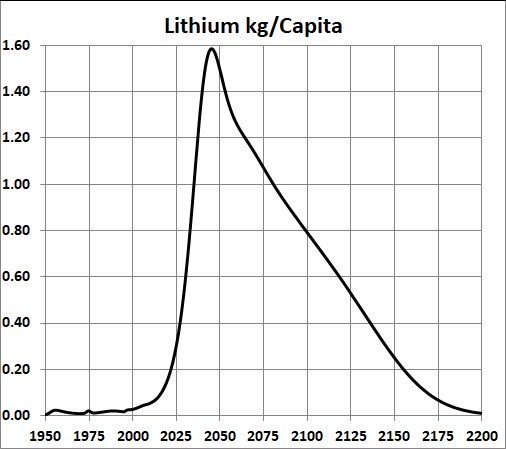
The recycling peak and the per-capita peak are both at year ~2100.
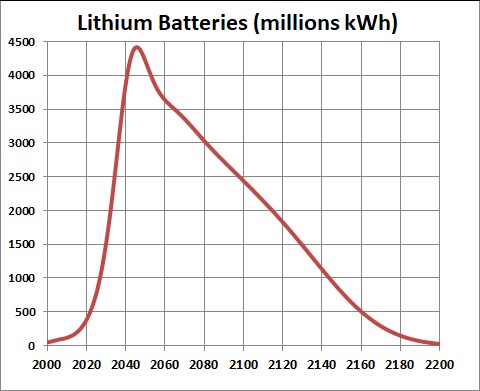
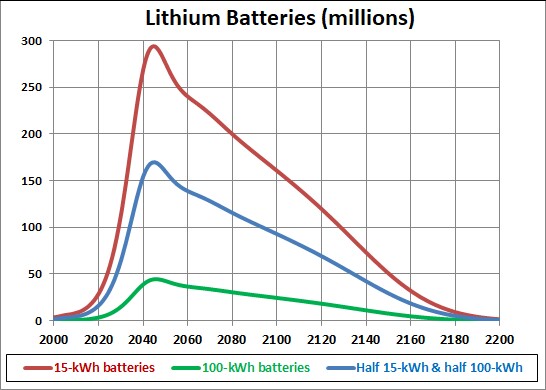
Using 0.3 kg for 1 kWh of lithium batteries, the following shows how many gigawatt-hours per year of batteries and how many 15-kWh and 100-kWh batteries per year could be manufactured as a function of time:
(Also, see this document.)
If all of the lithium batteries were 15-kWh batteries for plug-in biodiesel (made from algae) hybrid vehicles for a 45-mile electric range, an ideal future personal vehicle, the peak of the red curve would be enough lithium batteries for about ~220-million vehicles for that year, ~2040. Electric cars need ~100-kWh batteries for a 300-miles range, an even more ideal future personal vehicle; the peak year of ~2040 could provide ~35-million vehicles. Compare these numbers to the fact that 60 million vehicles are made in the world each year. Obviously, other energy-storage devices beside lithium batteries are needed after year ~2040.
Of course, there will be a huge demand for lithium batteries for storage of energy collected by solar and wind, so the number of batteries for vehicles will be considerably less than described above.
There are other battery chemistries that will compete with lithium for future vehicle batteries. My conclusion is that the situation for lithium batteries for plug-in vehicles is not as dire as projected by the Meridian International analysis, but it is serious.