Upgraded Rear Springs and Shocks
Web Links about the A123-Systems/Hymotion Plug-In Conversion
Problem with the Prius 12-volts auxiliary battery
Occasional Problem Starting the Hymotion System
Hymotion Solutions to the Starting Problem
EV Switch
State of Charge
PSD Lubrication Issue
Performance
CANView
Firmware 105 Upgrade
Replacing Defective Hymotion System
Links
Publicity
On 1-2 October 2008 I converted my 2005 Prius (35,500 miles) to the A123 Systems' Hymotion plug-in. The work was excellently done by Fitzergerald's Lakeforest Toyota of Gaithersburg, MD. They did an excellent job and were very helpful with all my needs. I was able to view the vehicle at various stages of the installation. It took about 6 hours to install the system. I arrived at noon and left before noon the next day; that allowed fully charging overnight the new additional 5.45-kWh battery. (It takes about 5 hours to charge it when it is empty.) (The original Prius traction battery is 1.32 kWh capacity.)
When Hymotion goes into EV mode, the Prius MFD jumps back and forth between the CANView screen and the Prius energy display. I found this disconcerting.
I have CANView version-4+ installed, which displays on a Lilliput EBY701 7" screen, which I placed in the floor space between the front seats.
I have ScanGauge. It and CANView are both connected to the OBD-II plug below the steering wheel by means of a OBD Y-cable.
The Green Car Company in Bellvue WA sells Prii with Hymotion and upgraded rear springs and shocks installed. One can buy the springs/shocks set with installation instructions. Call 425-820-4549 and ask for Don or Susan. The price was $899 including freight to Blacksburg VA. This seems high for two shocks and springs, but they had to to some study and experimentation to determine the proper ones to use to counteract the battery weight minus the weight of the spare tire and storage box that was removed.
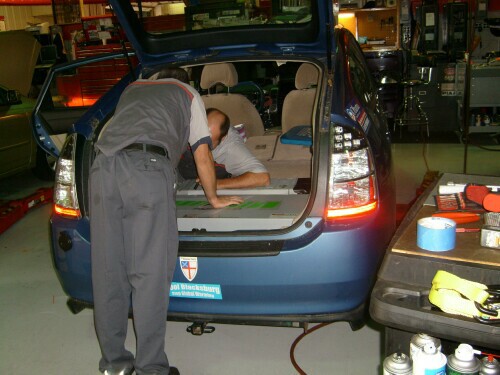
The 180-lbs Hymotion kit at the rear is approximately equivalent to a 300-lbs person sitting in the back seat. The removed spare tire and storage box probably reduced the added weight to about 150 lbs. However, my Prius has a hitch for carrying bicycles that weighs about 30 lbs, so my Prius has about 180 lbs extra weight sitting over the rear axle. The GCC tried several sets of springs and shocks to find which set worked best to level out the car. Some of the interior has to be removed temporarily to install the springs/shocks and the ABS line has to be unhooked and then rehooked. Installation should take less than 2 hours.
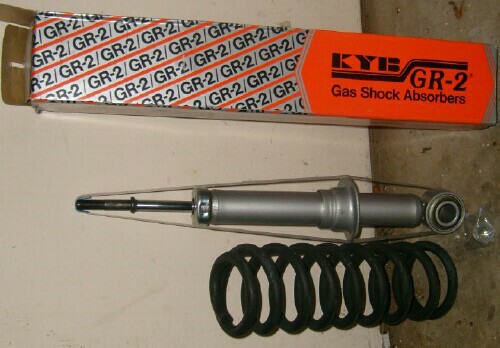
Collision Plus installed the springs for $330. They raised the car up slightly over 2" at the center of the back axle.
I had run down the auxiliary 12-volts battery in my Hymotion Prius by leaving lights on inside two times before the Hymotion installation. It ran down the installation night at Fitzgerald Toyota I thought because the three stop lights shine during charging. If the auxiliary battery gets to some voltage below 11 volts, the car will not start; there is a slightly higher cutoff voltage for the Hymotion system to turn on. It ran down again the next night while I was charging the Hymotion battery. I bought a new Toyota Prius 12-V battery and started to put it in myself, but decided that I do not have the right tools to get it out of the tight space it is in; so I had my Toyota dealer do it. (Advance Auto did not have the proper battery; I bought it from my Toyota dealer.) Shelor Toyota in Christiansburg did the installation; they told me that they had to un-attach the Hymotion battery to slide it over a little in order to get the auxiliary out, which I learned later is not correct.
Another local Hymotion owner and I are occasionally having a starting problem: Sometimes when the car is started after being fully charged the triangular ! sign, the check engine icon, sometimes the ABS icon or other icons shine and the Hymotion battery is not in effect. It happens more often after charging during a cold night. The Prius runs normally despite all those icons showing. Sometimes the Hymotion light above the Hymotion switch blinks 13 times at the same time, which is an indication of a low auxiliary battery, sometimes not. If I drive a mile or so and then turn the system off and then back on, it goes back to normal Hymotion operation.
I think that the problem is that running in EV mode runs the auxiliary battery down; apparently the auxiliary battery is not charged if the engine is not running. I have been able to stop the problem from occurring by using a trickle charger that plugs into the cigarette lighter when the Hymotion battery is charging. The cigarette lighter has to be wired to always be hot; I bought a kit from http://www.coastaletech.com/power_outlet_mod.htm to do that.
I wired an Advance Auto battery trickle charger into the Prius auxiliary battery, so that I can plug it in each time I charge the Hymotion battery:

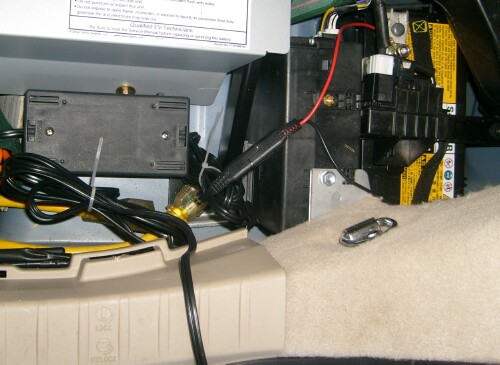
The black box on the left is the trickle charger. Its black double input wire and plug is left hanging out the back of the trunk. The red and black output wires to the auxiliary battery are shown on the right. If you do this, put a towel under the bolt that connects the negative wire of the battery to the chassis, so that you do not accidentally drop the bolt down in the gap behind the battery. Also, when you disconnect the battery, the alarm will sound in the car.
I plug in the trickle charger every time I plug in the Hymotion battery. I have not had the low-auxiliary-battery problem since I have been doing this, even on very cold days.
Later I replace the Toyota auxiliary battery with a deep cycle Optima yellow-top battery:
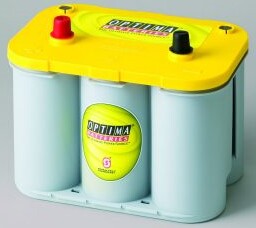
In February 2012 Mike Fox at New River Nissan wired the trickle charger into the Hymotion charging plug, so that a cord does not have to stick out of the trunk. After doing that the Hymotion system did not work and its dash light blinked 8 times. On the Internet I found the cause of the 8 blinks: "Inertia Switch: With the (trunk) floorboard removed and the car off, you will see a small hole in the left rear of the top side of the (battery) cover. It may be covered with a rubber plug. Under the opening is an inertia switch that deactivates the pack if the car gets in an accident or even a minor bump. Find a rod or drill bit that just fits through the opening. Using the back side of the drill bit (not the sharp side!), push down repeatedly on the inertia switch that's just below the cover. This resets the switch if it became activated. This fault manifests in 8 blinks." Before I had a chance to do the reset the system reset itself.
"We have two options for helping to ensure that our battery pack starts cleanly in the presence of a weak 12 volt battery. The hardware solution is for those that do not live within close proximity to a Green CHIP dealer. The software solution must be installed at the Green CHIP dealer. There is no advantage to having both systems in place.
"Hardware solution: This consists of a wire harness and transformer circuit, that plugs in between the battery pack and the vehicle side harness. This works by boosting the voltage, to the battery management system (BMS), to 12 volts. This does not boost the 12 volt battery – just the signal going to our BMS. This solution can be performed by someone with a moderate level of mechanical ability.
"Software solution: This requires the re-flashing of the firmware on the battery management system. The premise of this upgrade is to lower the sensitivity of our battery management system to that of the stock Prius.
"Neither of these solutions will compensate for a compromised 12 volt battery. These fixes just ensure that our Hymotion PCM does not complain before the stock Prius would."
PriusChat.com:  Re: Auxiliary battery problem with Hymotion
"Hymotion sent the L5 Booster to me about two weeks ago. The device plugs between the existing harness and can be installed a few minutes. Of course, I spent about 15 minutes making sure I was following each step. The hardest point was determining the pin to press down to unplug the existing harness. So far, everything has been working great. I have not had really cold weather since the installation which is when I would get the red triangle. I have attached pictures for everyone to see."
Booster device: 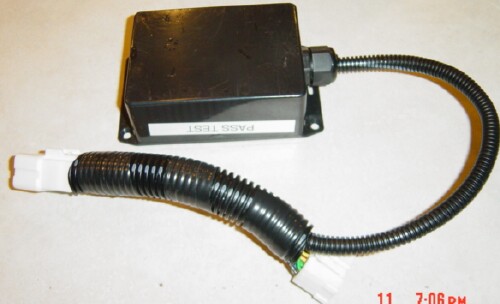 |
Plugs separated: 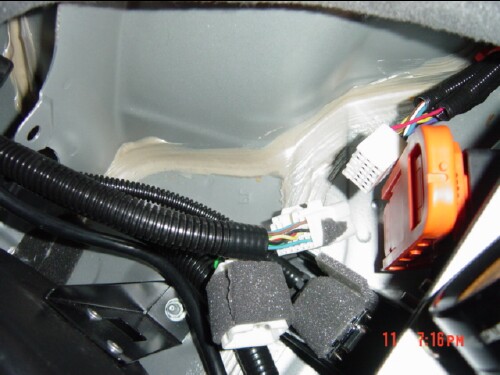 |
Booster installed: 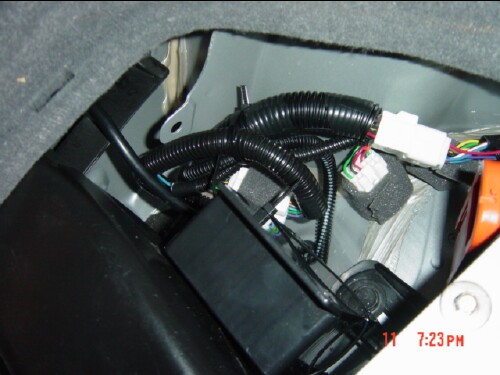 |
I got the Booster box on 11 March 2009 and installed it with no problem.
The new 12/volts battery I got from Toyota must have been sitting on a shelf for a long time, because it is weak. I noticed on the CANView MINMAX screen that the voltage got as low as 10.8 volts. After putting in the Booster box and not using the trickle charger, sometimes after cold weather I would have to press the Prius Power button more than once to start the hybrid system. Apparently the booster box was sending a higher voltage to the hybrid system after one or more tries starting it. So, now I am using the trickle charger during cold weather.
The A123-Systems/Hymotion plug-in conversion automatically puts the hybrid system in EV mode when the system starts, which keeps the ICE from turning on in 7 seconds after starting. However, once the vehicle reaches 34 mph the ICE turns on to warm up. After some ICE warm up and the vehicle slows down to a rather low speed, the EV mode is actuated again.
To get high mpg in around-town driving, one needs an EV switch to keep the gasoline engine (ICE) from turning on to get itself warm:
What gain is there by installing a manual EV switch? TheForce on priuschat.com: "You would gain control on when you need to use EV mode. Once you know when is the best time to use the button and when not to, a manual button would be better than letting Hymotion control it." "You would gain control on when you need to use EV mode. Once you know when the best time to use the button and when not to a manual button would be better than letting Hymotion battery control it. If you want to install your own button you will have to bypass the Hymotion connection or install a switch inline to select between the two." I do not know how to bypass the Hymotion connection.
However, Norm of hybridinterfaces.ca says: "Any EV module of any make just enables EV mode manually, just as Hymotion does automatically. So [putting in a manual EV switch would not allow] change to the EV cut-off speed. You would need the 52-mph hack that some outfits are promoting, but I do not as it requires you to pull over, stop and re-start before the ICE can run again which I feel is a major safety hazard. You can however right now maintain stealth up to 42 mph which is almost as good as EV mode. Doesn't help much downhill with Hymotion because they can't employ regen with their system. Remember there are any number of conditions that prevent EV mode and, just because you can press EV manually when the Hymotion doesn't, does not mean the Prius will accept that EV command."
Hymotion told me that the Hymotion 3-year guarantee will be voided if an EV switch is installed.
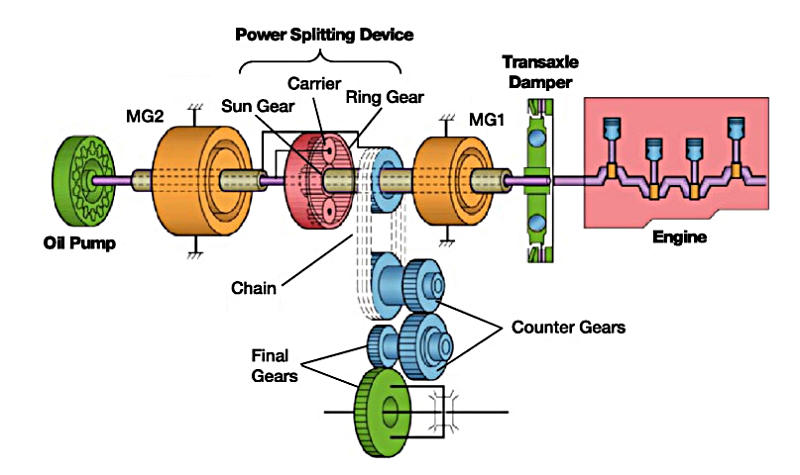
There is an issue about the need for the ICE to run occasionally to properly lubricate the power-split-device (PSD or transaxle):
"See this pic and this diagram. The pump is at the opposite
end of the transaxle from the engine, and sends a gentle flow
of transmission fluid down the assembly of shafts where small
holes let some out into the bearings along the way as well as
the final-drive chain. It doesn't seem to go much of anywhere
else, just ensures that those parts stay lubricated. The pump
is paradoxically turned by the *ICE* shaft which passes [in
two pieces] all the way through the middle."
"It is already pretty clear that the bearings [the majority of
which are ball or needle, so they're already very low-friction]
stay adequately lubricated over long periods of engine-off time.
The transmission fluid isn't involved in actual power transmission
like it is in a normal A/T; it's just a lubricant which is one
reason its service interval is so long. The jury is still out
on *very* long term lubrication issues, such as when weeks on
end go by and someone's commuting to work under EV only and
avoiding even the brief warm up run by invoking EV mode early
enough and staying under 34 mph. Just one shot of ICE-run now
and again is enough to circulate some fresh fluid down the
shaft assembly."
So, one should let the ICE run occasionally during drives where it is not needed for propulsion. Perhaps it is best to not use the EV switch until the ICE runs for a few minutes after starting the hybrid system.
With about 200 miles of around-town driving the Roper Prius is getting about 50% to 75% better gas mileage compared to what it got before the conversion. Another way to say it is that the mpg is increased by 20 to 40 mpg.
After running the Hymotion battery all the way down, here are some amounts of energy it took to fill it: 4.61 kWh, 6.1 kWh, 3.89 kWh, 4.69 kWh.
Before the Hymotion plug-in was installed I used the CANView V3 device to monitor many parameters of the Prius. It displayed on the Mult-Function-Display (MFD) of the Prius. When the plug-in goes into EV mode the CANView display is automatically turned off by the Prius so that it can show the energy display. I found this disconcerting. (The same thing happens when the navigation display is on.)
I wanted some of the new feature of the CANView V4+, so I replace the V3 by the V4+, which requires a dedicated 7" screen. I purchased one of the Lilliput EBY701-NP/C/T touch-screen displays recommended by Norm, The CANView inventor and marketer. Norm helped me get it properly installed through many e-mails.
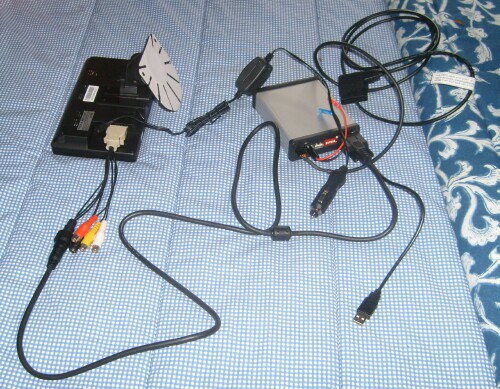
Here are the parts of the CANView system: The touch-screen USB cable on the bottom right has not been plugged in yet. The special OBD (On-Board-Diagnostics) plug is on the upper right. The screen is face down on the left. It gets its 12-volts power from the CANView box through OBD cable. There is a 12-volts power plug cable, an audio plug cable and two video cable that can be used for other video-devices input. I will use one of the video and the audio cable to connect to a backup camera on the back license plate. |
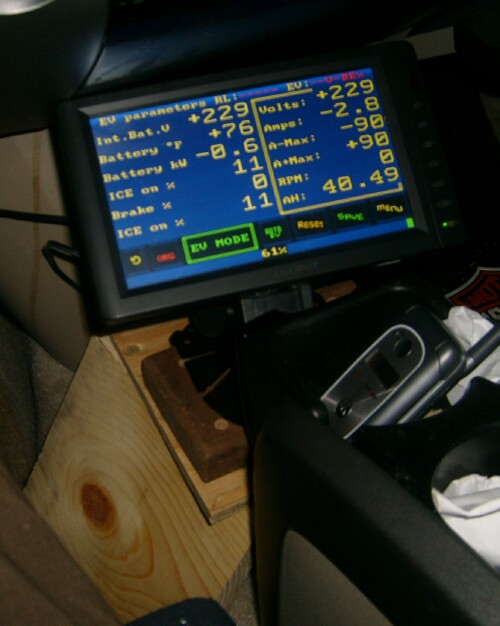
I built a stand out of wood to raise the display as high as possible and to hide the CANView box and cables under the display: |
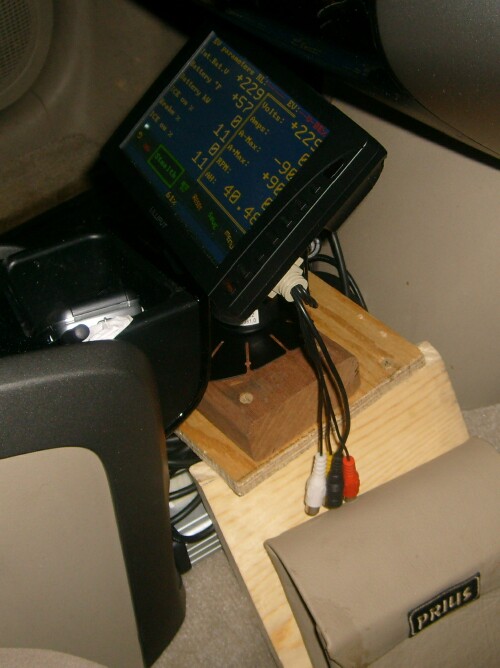
The CANView box is visible under the stand: Three of the four video cables shown could be used for a backup camera. |
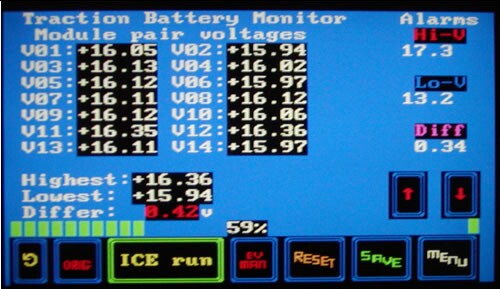
CANView menu: 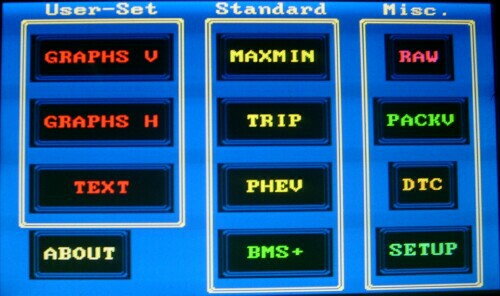 |
It shows voltages of the 14 module pairs of the Prius traction battery pack. (There are 28 modules rated at 7.2 volts each for a total rated voltage of 201.6 volts. Each module contains 6 NiMH prismatic cells rated at 1.2 volts each, for a total of 168 NiMH cells.) |
Many other CANView screens can be seen at http://www.hybridinterfaces.ca/graphics.html. |
On 4 December I took the Prius to the Advanced Vehicle Research Center in Danville VA to have the Hymotion firmware upgraded to version 105. The new firmware has the following features:
It took 45 minutes to download the new firmware.
On 7 April 2010 the Hymotion System quit working: The red light did not shine and the Pius display did not flip between the Prius battery and the Hymotion battery. The red light did come on briefly while I was driving and blinked three times. I e-mailed Hymotion and, apparently, the three-blink code told them that I needed a new Hymotion system. Advanced Vehicle Research Center in Danville VA then called me about replacing the system. On 14 April 2010 I drove 2.5 hours to Danville VA to have the battery replaced. It took about 1.5 hours to do the job.
I was told that the problem is that the DC-to-DC converter that converts the Hymotion-battery voltage to the Prius-battery voltage has had a hardware "lockup" problem on a few Hymotion Prii. They prefer to just switch out the Hymotion system rather than go into the battery case to replace the hardware in the field. The battery was sent back to Hymotion for repair.
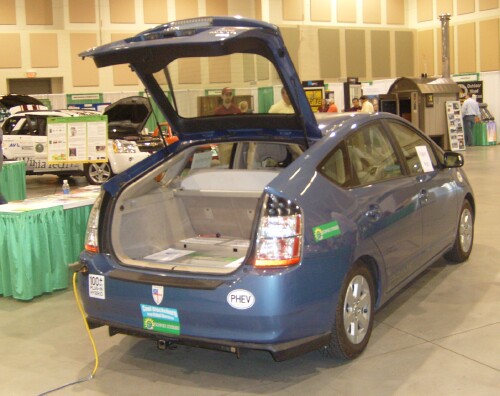
2008 Green Living and Energy Expo:
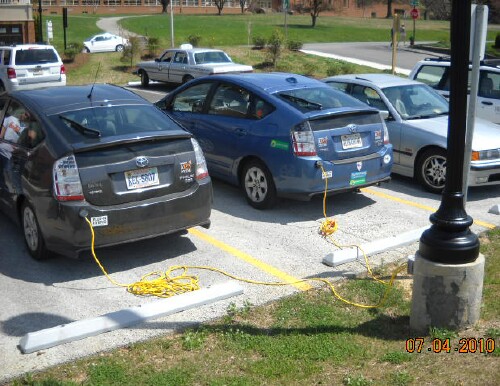
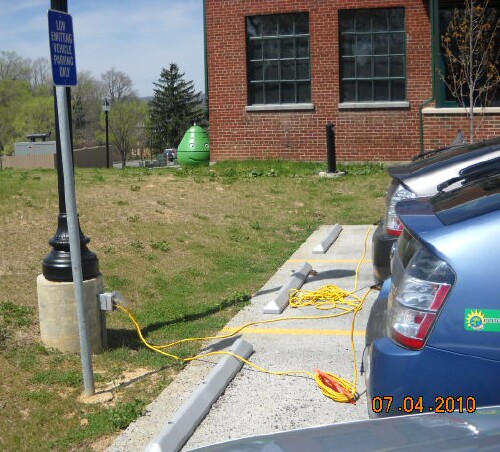
Plugging in my Prius and the Bixler Prius at the Blacksburg-Motor-Company building of the Town of Blacksburg VA:
 |
 |
L. David Roper, http://arts.bev.net/RoperLDavid/