L. David Roper
http://www.roperld.com/personal/RoperLDavid.htm
1 April, 2017
The article “Physics in the oil sands of Alberta” in the March 2009 issue of Physics Today was very informative. However, the authors did not adequately answer two of the most important science questions that need to be answered about extracting petroleum from oil sands:
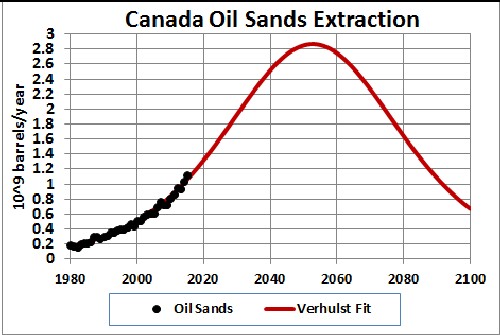
The article prompted me to look into the depletion of Canadian oil sands. Using the extraction (not “production”, resources are “extracted” not “produced”) data for 2000-2008, the projection of extraction until year 2020, and the generalized Verhulst function, which allows time asymmetry, to fit the meager data and projection, the red curve in the graph is the best fit.
However, the article states that “Alberta’s bitumen reserves-the amount that can be recovered economically with current and foreseeable technology-are estimated at 172 billion to 315 billion barrels.” Fixing the amount to be eventually extracted at 200 billion barrels yields the fit given by the blue curve in the graph. The latter fit is only slightly less good than the best fit of 73.5 billion barrels to be eventually extracted. Future data over the next few decades are needed to determine a reliable depletion curve for the extraction.
World crude-oil and other petroleum liquids are peaking about now (2009) at about 32 x 109 barrels/year. Compare this to the possible peak of
~3 x 10⁹ barrels/year at about year 2047 for oil from Canadian oil sands:
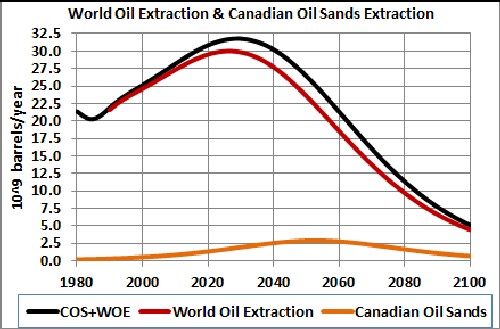
So, COS oil extraction will be a small increase of world oil extraction.
If all of the Canadian oil-sands oil were available to the United States, with its rapidly declining oil extraction, the available oil to the U.S. would be:
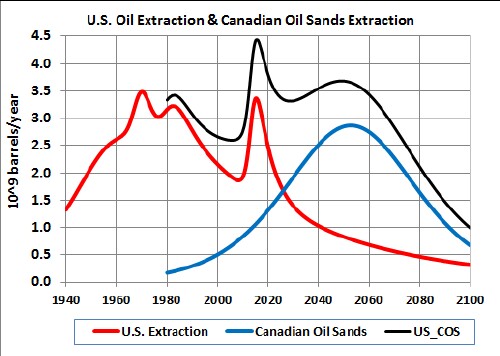
It easy to see why the U.S. is so interested in building a pipeline from Alberta, Canada to the southern coast of the U.S. However, doing so would make the COS oil easily available for export to other countries that might be able and willing to pay more for it than the U.S.
One has to ask: Is it better to spend valuable water and landscape to get oil from oil sands or to develop renewable energy?
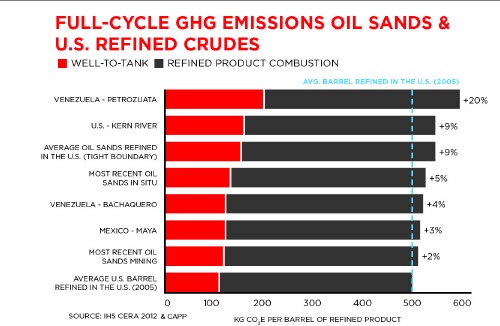
Politicians and citizens need information such as these curves, net energy and carbon dioxide emitted to make informed decisions about whether to allow processes such as extraction of petroleum from tar sands.
http://arts.bev.net/roperldavid/interdisciplinarystudies.htm